
An ontology to define how your team works.
This is the new era of systems engineering, where an ontology is no longer a static blueprint but the runtime language that connects humans and machines.
Talk to an engineer- 01
Define the ontology, evolve it
The blueprint of your domain: which element types may exist, the properties they carry, the relations allowed between them, the rules that govern them, and the queries that check them.
Your terms and processes, versioned so the model evolves without losing the knowledge of what was done before. All underneath our engine, so that teams can evolve without disturbing running engineering work.
- 02
Use engineering tools, evolve your engineering methods
Design, simulation, PLM, manufacturing, test and the agents working alongside them each hold a piece of the same system.
The ontology is the vocabulary they share, and its API is how they reach it: one digital thread through the programme, instead of another island.
- 03
Model your systems, ground your design choices
We call it ARC, our systems engineering software that runs directly on the ontology. It is a live workspace for your programme, not a static report or a separate tool.
Every requirement, component and verification is an instance of one of the ontology's types, joined by typed relations instead of prose cross-references, with parameters carried as values or formulas. Change one and the model already knows what depends on it: impact, coverage and gaps are live queries over the graph, not reports somebody keeps up to date by hand.
- 04
Ground your engineering intelligence
Because the structure is explicit, AI reasons on the system itself instead of searching text. Ask in plain language and get the answer with the path through the model that produced it.
Your ontology, open in ARC.
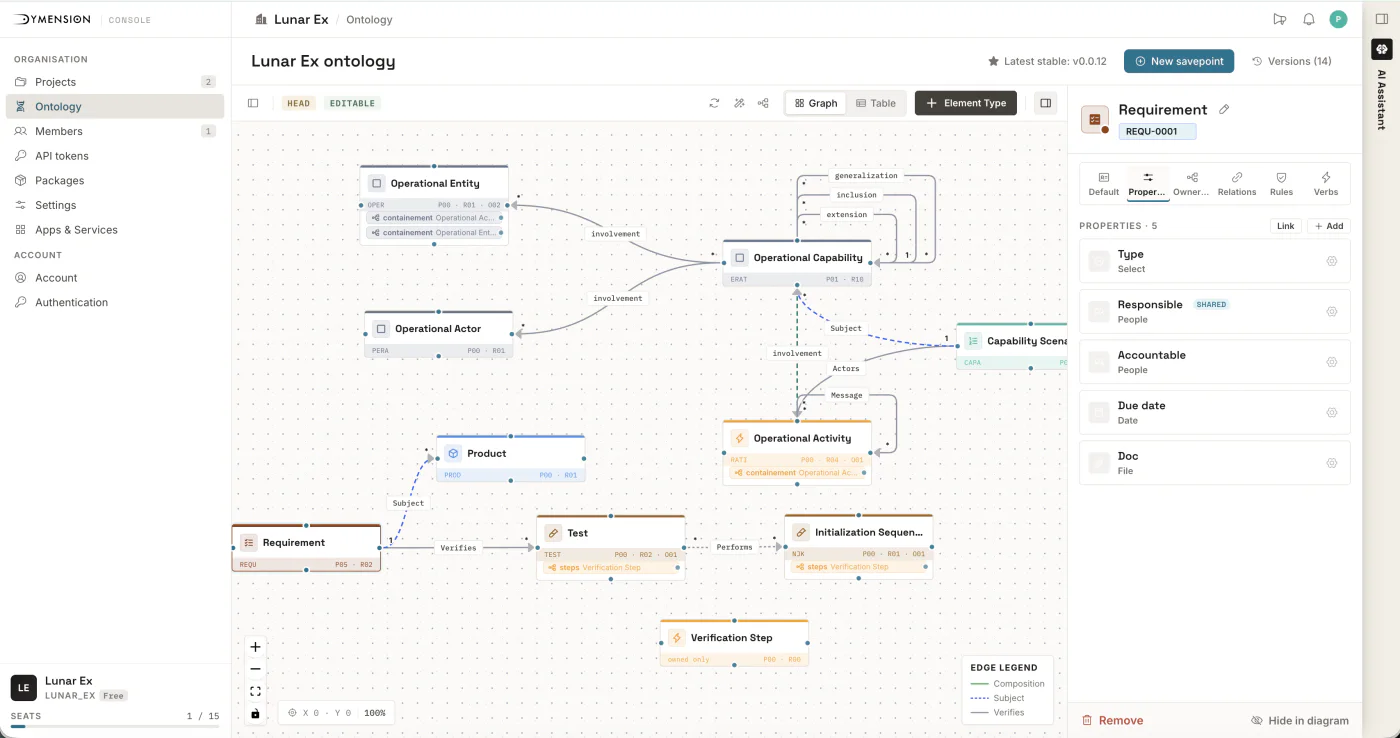
The element types a programme works in, the relations allowed between them and the properties each one carries, as one graph you edit directly. Saved in versions, so each project pins one while the ontology keeps evolving.
Deployed where your programme is allowed to run.
ARC runs on our EU sovereign cloud by default, so data stays in the EU on every cloud plan. Where a programme needs something else, that is a deployment decision rather than a limit: another region, your own private cloud, or a network with no route out.
- Default
EU sovereign cloud
Every cloud plan runs here. Your data stays in the EU, which is the first question every European aerospace team asks.
- On request
US cloud, or another region
Tell us where the programme's data has to sit and we deploy there. The region follows the contract, not our default.
- Enterprise
Private cloud and air-gapped
Your own tenancy, on-premise, or air-gapped, for programmes under export control or classification.
Deploy ARC with us. Help shape how complex systems are engineered.
For consultancies, integrators and specialists helping complex engineering teams move their work forward. Whether you shape the approach, bring ARC into a programme, or build new ways to use it, we are open to design and deployment partnerships. Help us shape the next steps around the issues you are facing and deploy it together.